As part of my ongoing exploration of inclusive approaches to group work, I recently had the opportunity to observe the ‘Project Hour’ session of a mandatory Liberal Arts unit that teaches basic data science from a humanities and liberal arts perspective. The ‘Project Hour’ followed a lecture on ‘Oppressive Algorithms’ and was led by James Freeman and Jamie Perry, who have introduced Team-Based Learning (TBL) in their teaching this 26/27 academic year. For the last 10 years, group work, in various forms, has been done in the unit, but it is only in recent years that the whole second hour of their whole cohort sessions have been turned over to active learning and project work.
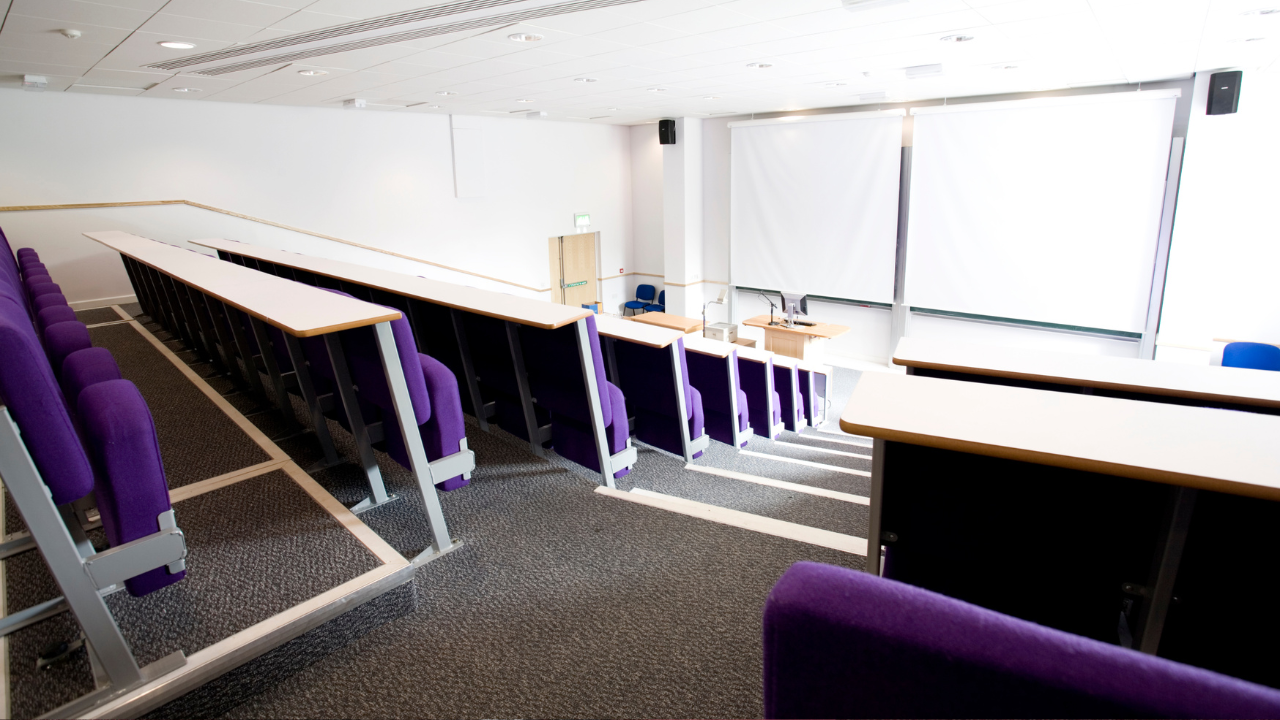
What particularly interested me was not just the pedagogic approach itself, but the setting. The session took place in a traditional tiered lecture theatre with fixed seating, exactly the kind of space that is often assumed to be unsuitable for collaborative learning. Yet what I witnessed challenged that assumption entirely.
Building teams with student agency
The session I observed was the third of this whole cohort setting with just under 50 students attending. Students had also had three weeks of workshops where they work in their project groups. Prior to the start of the unit, students were surveyed about their group work preferences via a Microsoft Forms. The survey included questions around whether they preferred a highly social group, a task and finish style one, or a mix; the roles they were keen to play and an opportunity to name one person they wanted to work with. There were also some questions around digital skills competence and academic literacy where students had to rate their familiarity on skills such as developing a research question, building a reading list, using Excel or OneDrive, so teaching could be tailored accordingly, and support given where needed.
Rather than assigning groups arbitrarily, these preferences were taken into account when forming teams. Students therefore had a degree of agency in the process, which is an important consideration when thinking about inclusive group work. The group allocations were then organised manually using an Excel spreadsheet that was generated from the Microsoft Forms, ensuring that as far as possible preferences were met, as well as making sure the project teams were in the timetabled workshop groups.
Each team consisted of around four or five students to cater for absences. To help the session run smoothly, once groups were formed, a seating map was shared so students knew where to sit and who their teammates would be. In a fixed-seating lecture theatre, this simple organisational step removed uncertainty and enabled students to settle quickly into their collaborative groups when the time came, as in the lecture prior to the ‘Project Hour’ students can sit where they like.
From individual thinking to collective problem-solving
The session began with a five-minute Individual Readiness Assurance Test (iRAT). Students completed the four multiple choice questions independently using FeedbackFruits, which was integrated in Blackboard Ultra with the support of the Digital Education Office (DEO).
The short assessment consisted of multiple-choice questions that required students to consider scenarios and identify sources of injustices that can arise from algorithmic decision-making causing potential bias in data collection. Some questions were scenarios equivalent to those in the previous lecture, but not the same ones, serving as a useful knowledge check, while others built on material students had engaged with before attending the session.
Once the individual phase ended, students moved straight into the Team Readiness Assurance Test (tRAT), discussing the same questions and agreeing answers collaboratively.
This is when the atmosphere in the room changed immediately.
The power of purposeful buzz
One of the most striking aspects of the session was the energy. The room filled with conversation as students worked together to justify their answers, challenge one another’s thinking, and arrive at a collective decision to the tRAT.
There was a clear sense of engagement and even a small element of competition.
I asked whether this competitive element could create anxiety for some students. Jamie explained that the TBL process had been carefully introduced in earlier sessions. Expectations, aims, and ground rules had been discussed openly with students, and these had been shaped in the first workshop through the Group Work Charter that included insights from previous cohorts. Rather than competition being imposed, students understood the rationale and boundaries from the outset.
Whilst there is a prize at the end – it’s for winning the overall league not for each week, to reduce pressure on any question or mistake. The scratch-card style answers also reduce the pressure and everything is weighted in the final score on the Team, not the individual as this is not a summative assessment.
Students have also been promised that individual scores will never be revealed and that only the top X teams will be displayed in the updates, not the bottom ones.
This preparation and approach appeared to make a significant difference. The competition felt light-hearted and motivating rather than intimidating.
Learning with a sense of joy
After completing the team assessment, scores and league table standings were shared with the cohort. It was impossible not to notice the excitement this generated. Students were invested in the process and interested in how their teams were performing.
The session then moved into an application activity where teams worked together to apply their understanding to a more complex task.
Again, what stood out was the level of focus. Despite being in a traditional lecture theatre, students remained on task and actively engaged with the activity. The space itself did not appear to be a barrier to meaningful collaboration.
In fact, there was something genuinely uplifting about observing the session. The room was buzzing with discussion, students were debating ideas, and there was a palpable sense of enjoyment in the learning process.
Inclusive group work is about design, not just space
One of the key insights that was reinforced by this experience was that inclusive collaborative learning does not depend solely on having flexible classrooms or specialist active learning spaces. While room design undoubtedly matters, thoughtful pedagogic design matters more.
Student agency in team formation, clear communication of expectations, carefully structured activities, opportunities for both individual and collective thinking, and the establishment of shared ground rules all contributed to the success of this session.
The physical environment may not have been ideal on paper, but the learning design enabled students to participate meaningfully and confidently.
A final thought
As universities continue to think about active and inclusive learning, it is easy to focus on the limitations of our teaching spaces. However, this session was a powerful reminder that innovative and inclusive practice can flourish even within traditional environments.
I would also like to acknowledge the work of the Digital Education Office in supporting the use of tools such as FeedbackFruits, which helped facilitate the readiness assurance test (RAT) process and supported the overall TBL approach.
What I observed was more than students working in groups. It was a carefully designed learning experience that fostered engagement, accountability, discussion and, perhaps most importantly, a genuine sense of joy in learning, thank you James and Jamie for this opportunity to see TBL in action.
I’d love to hear from others using Team-Based Learning. If you are engaging with it, how have you adapted TBL to your teaching spaces, and what impact have you seen on student engagement and inclusion?
Further reading
Team Based Learning Masterclass – Bristol Institute for Learning and Teaching



Leave a Reply