with Paul Wyatt, Professor of Chemistry and Education

BILT
Hi Paul, thanks for joining us. What are you up to in terms of active learning?
Paul Wyatt
Where I do 2nd and 4th year lectures, I’ve moved to an entirely flipped format. The 4th year lectures are all delivered online and then in the lectures themselves, I’ve got some stuff planned to go through where I’ll put questions to the audience and I’ll try to get a bit of a seminar going.
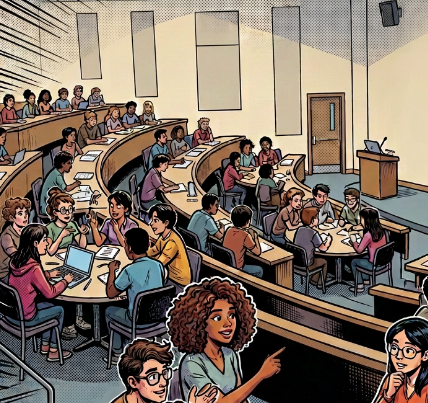
In the second year, because it’s a larger class, it’s the same deal. It’s all flipped, but in order to try and get a bit more interaction from them, I get them put into groups first. So then I can ask the groups to contribute.
I’ll say ‘you need to get into groups and the first thing you need to do is come up with a group name’, which I thought would be quite helpful, but also, inadvertently, this serves as an icebreaker because the students quite like the fun of coming up with a group name and they can chat about that and don’t have to worry about whether they do or they don’t know some chemistry in order to do it.
It’s very lively as they come up with group names, and I encourage them to try and come up with funny ones, you know, or better ones – ‘I predict a Wyatt’ that kind of thing, so that’s quite good, and allows me to call out a group rather than individual.
There’s a collective responsibility, which is much gentler than saying, ‘John, what do you think about this?’ If I’m not getting contributions from people, I can say, ‘Well, “Carbonyl Four”, we haven’t heard very much from you’ or whatever, so I’ll try and do that and that works quite well early on.
I tried keeping score of how much groups contributed, but what I found is they’re quite enthusiastic about it when I start it, but they either get bored of it or they get disillusioned with it because it’s really difficult to keep the momentum going.
I think the student response to [active learning] is quite Marmite, really. Some of them really like the flipped format. Some of them do not like it and in fact they just want passive learning. They’ll say ‘this stuff in lectures where he waits for us to comment is all a waste of time. You know, he should just tell us the answer. Why doesn’t he just tell us the answer?’ They just want me to kind of lecture at them rather than anything else.
BILT
And do you ever address that then? Not directly with a student maybe, but in terms of ‘this is why we’re doing this,’ or ‘what we’re doing is…or…’
Paul Wyatt
I do start at the beginning. I talk about that. I could possibly do that a bit more thoroughly, but you can also get a backlash from that. I’ve had students say, ‘we don’t like it, and when he explained, he tells us why we’re wrong’.
Whereas I’m just explaining why I do it. Actually, the evidence is all too plain that it’s not wrong, but they don’t like it.
I find the lectures quite dynamic. I think they’re quite interesting and I feel that I’m doing something where they would learn more because I’m responding to them. So, I say to them, ‘you’ve got the agency, I’ll do what you want’. And some of them really like that. And I get students saying, ‘oh, he does what we want, even if it’s not the lectures’. Some of them hate that. It’s kind of, ‘why is he doing these other things? Why doesn’t he just tell us what’s in the course rather than other stuff?’ Because someone else wants to do orbitals, so I do it. And the reaction might be ‘well, I don’t want that. Just tell us what’s in the course, to tell us the answer. What do I need to say in the exam?’.
You’ve got this whole section of students that are really conservative about how they want stuff done, which you’re battling against. The worst thing you can do is to say, ‘has anyone got any questions about this?’ and expect an answer. You’re not going to get anything. So I say, ‘OK, here’s something for you to think about in your group’.
I think about this and give them a bit of time to think about it. Then when I say, okay, ‘what have you got for me?’ And then there’s just silence, because they haven’t talked about what I want. Some of them will think ‘what a waste of time, what a waste of time. We’ve got all this silence we have to sit through, well, you can just tell us the answer’.
I think [the active engagement] does vary by year. Some years it just works really well. One observer said how impressive it was that the students were prepared to speak and how engaged they were and what a rapport we had and it was a good session.
It is hard work, and there’s no two ways about it. Sometimes it just doesn’t work because you have resistant people who they don’t want to engage. And other times it does.
BILT
I’m really enjoying the nuance of how you’re talking through the group dynamic. When you call on groups, do you find it’s generally the same person that is the spokesperson for the group, or does that vary?
Paul Wyatt
Completely. In fact, we had a group this year which was being represented, but they clearly weren’t. I ended up calling him ‘Michael’. And I because he came down at the end and was asking me some interesting questions, I knew his name. So I stopped calling out the group and I just said ‘Michael, what do you want?’.
I was talking to him at an exam surgery and he noted what had had happened and said ‘oh, well, some people have commented because I contribute so much‘, and he referred to himself by some negative label he felt the others had applied. I said to him, ‘well, what are these other people who don’t contribute at all? What are they in that case, you know?’.
It’s that classic thing where you have people who don’t do anything. They’ve never achieved anything and the way they try and bring themselves up is by dragging other people down.
BILT
That reminds me of a quote linked to that which is ‘it’s not the critic who counts’ by Theodore Roosevelt and about passing judgement when you’re not active within a space and whether you are therefore restricted from that privilege.
Paul Wyatt
It’s interesting you mention Roosevelt there, because actually I was using one of Eleanor Roosevelt’s comments just this week, which is, ‘no one can make you feel inferior without your consent’.
BILT
Interesting to hear you discuss the relational side of things as well. So, you are persevering with that idea that it’s valuable and it’s an important principle to hold on to and that for their active learning they need to be challenged and discussing things and you get out what you get in?
Paul Wyatt
I suppose part of that is selfishness in that I don’t want to go back to the old style. I’ve been there and I’ve done the ‘lectures’. Doing it in that style is boring for me and I think if it’s boring for me it’s going to be boring for them and I would rather do something in the lecture theatres that is dynamic and receptive and gives them agency.
What’s interesting is the ones who say, ‘oh, I don’t like what he’s doing’. Okay, you are at liberty to ask me to do what you want to do, you know, but if you’re going to sit there and be silent about it, don’t complain when someone else says we want to do these other things and you don’t like it.
BILT
So if you were sort of giving some advice to other academics about trying to introduce some active learning, or student involvement, rather than being passive recipients of traditional lecture-style teaching, what would be some practical things that you would suggest or recommend?
Paul Wyatt
I would say don’t do it wholesale. Just try changing one or some of these approaches. I think that might go down better with the students. It is one of the things that students have said is ‘why do we have to have it all like this?’. So you could just do one or two and see and see how it goes.
The other thing I would say is the whole scaffolding of it. As I’ve said, get them into groups and then chat with each other so you’ve got the icebreaker. It’s an icebreaker without calling it an icebreaker. Never call an icebreaker an icebreaker if you can avoid it, I think, because as soon as you say that people think, ‘oh God, is it going to be post-it notes? I hope I’m not going to have to stand on a table. I’m not standing on a table for anyone’.
You know, everyone dreads an icebreaker. But if you just say, ‘we’d like to come up with a group’ or, another thing I’ve done in workshops where we said the activity is you have to come up with a list of how you’re going to interact with each other. They come up with things, then I get that on a big piece of paper and get them all to sign it. It’s not long before they’ve broken their rules, but they came up with the rules, not me.
You can do something anyway to get them all involved.
People do ask me sometimes ‘well, what about people who don’t want to be involved? You know, what about what about those?’ I mean, I don’t push it at all because I think it’s difficult enough to get people to attend. If they’re going to start feeling uncomfortable about attending, they’re just not going to come.
So, I just don’t bother. Occasionally, I’ve had people who if they don’t say anything, I just let them. Occasionally, they’ll say, I don’t want to be involved. in which case, I’ll say, well, look, you can be in a group of one, then in that case, that’s your group… If you’re starting out with these things, something Tansy Jessop used to say about having fillers and exit route – always have something in your back pocket. If it’s a disaster and they don’t come up with something they want you to talk about, or they come up with something that they want you to talk about that you can’t really talk about, have something that you can do.
Somebody asked me this at a conference; when I say, ‘what would you like me to do?’, either it’s ‘what you want me to do next time, or what do you want me to do now?’. But someone said to me, well, what if they come up with something that you can’t do, you know, or that you need to prepare for? You know, how do you manage that?
Well…I don’t manage that. I just throw myself out there and do it. But you could manage it. You could say, OK, everyone, we can do one of these three things that you’ve prepared. Which one would you like to do? And then you’re giving them agency without actually putting yourself too much at risk because you can do any one of those three things. That would that would work as well.
BILT
That’s good to have the ‘off ramp’, and people sharing that on a Padlet or a Menti..
Paul Wyatt
If you want people to contribute, do it on a Menti.
A colleague of mine said, ‘well, I asked them what they wanted to do and I didn’t get a single person to reply’. I said, ‘well, how did you do it?’ I said, ‘Well, I asked them to email me for next week and nobody did’. I thought, well, what do you expect?
You’ve got to do it there and then. You’ve got to have a Menti so people can put their stuff up there.
If you do, you’ll get lots of responses. I just have it free form, but you could do voting, i.e. do you want to do one of these three things? On one of the weeks, because two things emerged, I said, ‘well, we can do this or we can do that, which would you like to do?’.
BILT
Thanks, Paul. One other question was about those ‘tumbleweed’ moments that you sometimes might get within that. Do you have any approaches or things that you do in those moments?
Paul Wyatt
Sometimes, if I don’t get anything, I tend to I say, ‘let me give you a bit more time’ and give them a bit more time with it. What you can end up with is an anti-Socratic setup all too easily, which I really don’t like, which is that they learn that if they’re silent for long enough, you just give them the answer.
I don’t like responding to silence by just giving them the answer.
Sometimes I’ll say, and I’m not sure this is best practice, because they really hate it, ‘I say, well, okay, I’ll let you think about that then. Maybe we can talk about that next time’.
Silence gets you gets you nowhere and so I like doing that.
If someone had said, ‘the trouble I have with this question is…’ whatever, and they started a discussion, then we’d get somewhere.
I could be up front with them and say, sometimes this works really well and sometimes it doesn’t. But the time it works well is when everyone joins in.
The other thing is, I went with the silences, I’m quite comfortable with the silences.
I saw this done once with a senior tutor. When I was a student, he asked a question to the room and there was a silence and he just waited. He just waited until someone said something rather than trying to fill that silence. It’s a difficult one. I think you have to use your judgment. I’m not sure I’ve got it right yet. This silence even when you’ve tried to scaffold discussion is an area that still needs work.



Leave a Reply