The 12th TV series in the Star Trek franchise, Starfleet Academy, presents a far-flung future university for space explorer students, known as cadets. Everyone is very young, shiny and diverse, each with their own angsty quirks and special interests. The teaching staff are as varied and prone to imperfections.
This blog focuses on the questionable pedagogic practices employed by the teaching staff in this tonally-uneven television experience. As I’ve watched the series, I have frequently mumbled dissatisfaction at the learning environment, hostile attitude from teaching staff, and lack of planning involved! If nothing else, the show will make us all feel better about our teaching practices.
Student research
A enthusiastic holographic student, SAM, enrolls late to a unit called Confronting the Unexplainable, a unit that seems to have no discernible intended learning outcomes.
The independent research project undertaken by SAM showcases the complete lack of preparation and scaffolding provided to students. While undertaking qualitative research, she ends up offending an entire religious group of fellow students. If only she had some ethics and cultural preparation in advance!
While SAM has complete autonomy to explore her chosen topic, the subject causes her to experience severe existential panic. She is also under enormous pressure from her “parents” (floating orbs of light) who demand she achieve total success within seven days or she will be forced to leave the Academy forever. A late-in-the-game supportive intervention from her teacher helps her navigate parental demands and research success to renew her self-confidence and positive attitude for a future of her own making.

Reflective comment:
- The freedom the student experienced was liberating, but in many ways she was set up for failure by a lack of direction and initial support from her teachers.
- She also faced immense pressures from outside the Academy that were invisible from her fellow students and teachers.
Learning environment
At one point, students are thrown into a realistic team combat game called Calica. Do they receive any prior preparation or instruction? No! Do they get shouted at and shamed for failure? Yes!
The experience is a version of laser tag with a timed penalty box for anyone hit with a laser. Students get to try again and again while in the competitive venue. Unlike laser tag, the learning environment is full of explosions and noise, recreating a realistic battlefield.

Reflective comment:
- Students are pitted against their rivals in the War College, fostering resentment and competition between two complimentary institutions of Starfleet.
- Being placed in a high-stress simulation is appropriate for students in this context, who need to be able to act under threat of fire, but the lack of preparation adds unnecessarily to the stress endured.
Emotional connection
The boss of the Academy sees one student who was raised to hate everything the Academy stands for. She takes a one-to-one dialogic approach to bring the resentful student into the fold of the Academy’s values and helps him to embrace the learning experience; she does this largely out of guilt and adopts a motherly role towards him.

The holographic Doctor teacher overcomes centuries of emotional detachment in order to connect with the injured holographic student. Ultimately, he adopts her as his own child becoming a real father figure to her.
Reflective comment :
- While the student outcomes are positive, the teachers move beyond pastoral care into parental roles.
- One teacher was empathetic from the outset, so the student knew he would experience emotional safety with her. The other was resistant until he could see how much damage his lack of empathy was causing and only then did he change his ways.
Cultural dialogue and trauma
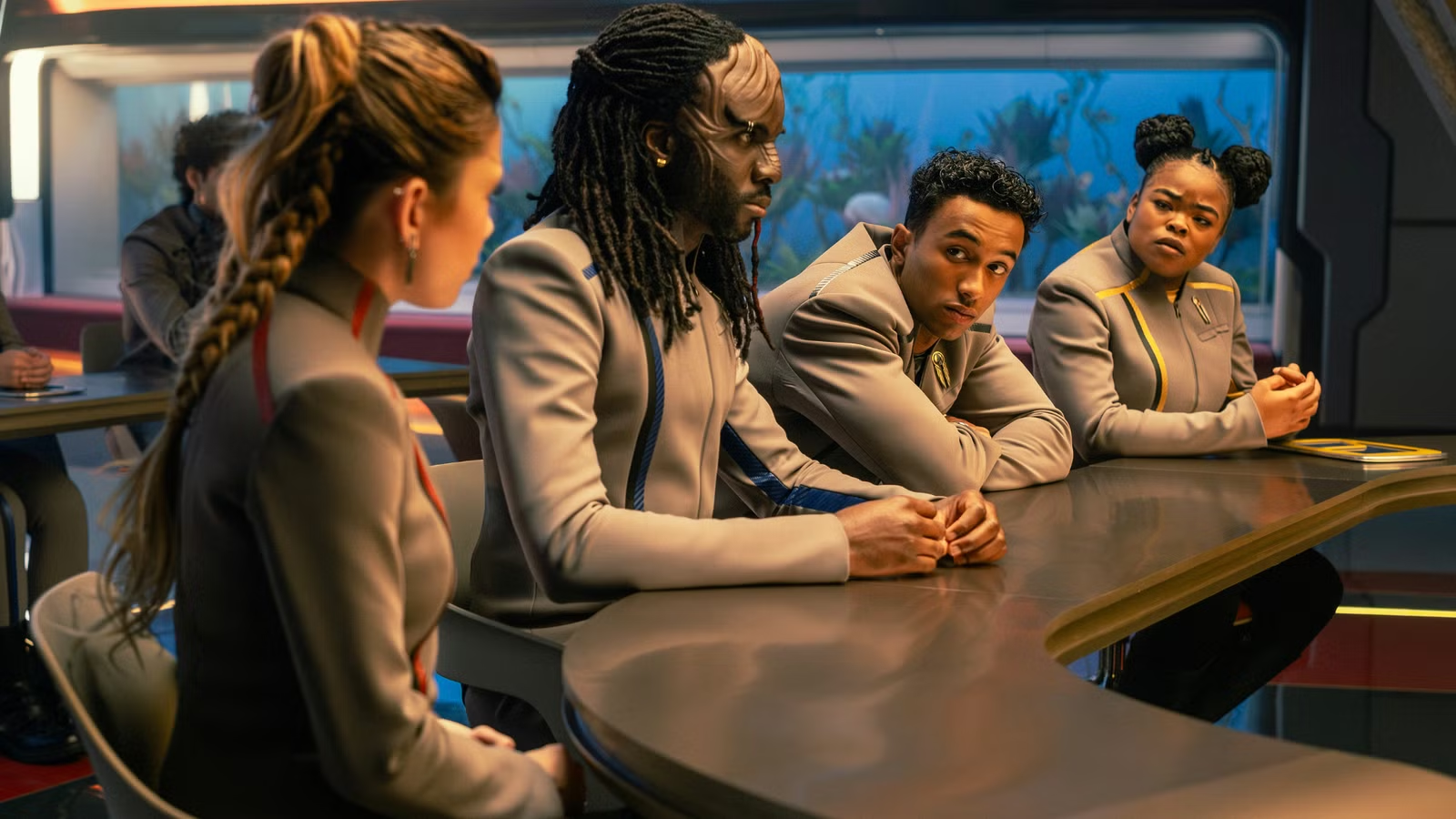
Students are tasked to undertake a debate on a subject of their choosing. Somehow, the most emotionally traumatised student (Jay-Den), whose race is facing extinction (the Klingons), gets staff to agree to debate his diaspora and refugee status, and whether they join Starfleet (for their own good) or not (respecting their independence).
The grumpy teacher in charge of the debate lets students engage in the topic despite his concerns it will only traumatise Jay-Den more. The issue is even more exacerbated because of Jay-Den’s public speaking anxieties and panic attacks. It is the other students who help him to overcome his fears, rather than his teachers.
The second in command of the Academy is partly from this diaspora so she understands his cultural values and reference points. She understands that the solution to the debate and political situation is to respect the diaspora’s cultural norms, but she doesn’t directly hand that answer to the student, she helps guide him to the answers.
Reflective comment:
- The grumpy teacher respects students’ freedom of speech even when they venture into xenophobic and culturally-ignorant territory. He also doesn’t enforce a boundary when he knows that it could emotionally damage a student, instead he enables their wishes for the specific debate topic.
- The situation also engages with concepts of decolonising the curriculum, since most Academy students take a Starfleet perspective rather than seeking to understand the diaspora’s Klingon cultural perspective.
Teaching team
The teaching team take inconsistent approaches to the programme of study.
The leader of the Academy, Nahla Ake, is deeply empathetic and champions student agency, and takes a barefoot 70s approach to freedom of choice in the curriculum. The Doctor is perennially grumpy and rude to students, and doesn’t care about student choice and agency by default. The second in command, Lura Thok, is likewise strict and exacting, she goes a step further to shout at and penalise students with push-ups. The students respect the skills of these two instructors but are often fearful of how they will respond in any given situation leading to a lack of trust.
Ad hoc instructor Sylvia Tilly arrives briefly to teach the students the value of drama to diplomacy, but is terribly gruff to a recently-traumatised student, forcing her to face her trauma in front of her peers. Professor Illa Dax lets a student join a unit mid-term and takes a hands-off approach to supporting student independent research, but at least she doesn’t snap at the students.
Final thoughts
The show itself is an uneven mess with some minor highlights, so is not recommended for sci-fi fans. But it is thought provoking to analysis from a pedagogic perspective: why is some teaching practice utterly woeful? Where do the characters sometimes succeed and how? What values and theories emerge from the chaos of the writers room?
Seeing an imagined future space university through the eyes of American TV writers demonstrates some of the tropes of how higher education is viewed, how teachers are imagined, and how contemporary issues can manifest in learning. It can help us reflect on our own approaches and values in a UK context.






Leave a Reply