Introduction
Medical education increasingly emphasises incorporating teaching opportunities to undergraduate medical students to prepare them for their future academic and clinical roles. One approach to integrate teaching skills into the undergraduate medical curriculum at the University of Bristol, is through the Student Choice Project (SCP). SCPs allow undergraduate medical students the chance to engage in specialist study within an area of interest. Examples of SCPs include time in the anatomy room, learning about AI in healthcare, and exploring yoga as a wellbeing aid. This blog focuses on a SCP which offers the opportunity to learn how to teach.
‘Designing and delivering a teaching session for primary school children’ is led by Ciaran Conway and Sarah McLaughlin. It introduces students to pedagogical theories and teaching practices. During this teaching-focused SCP students learn foundations of teaching, inclusive pedagogy and literature review techniques, before designing and delivering a 40 minute session in a local primary school.

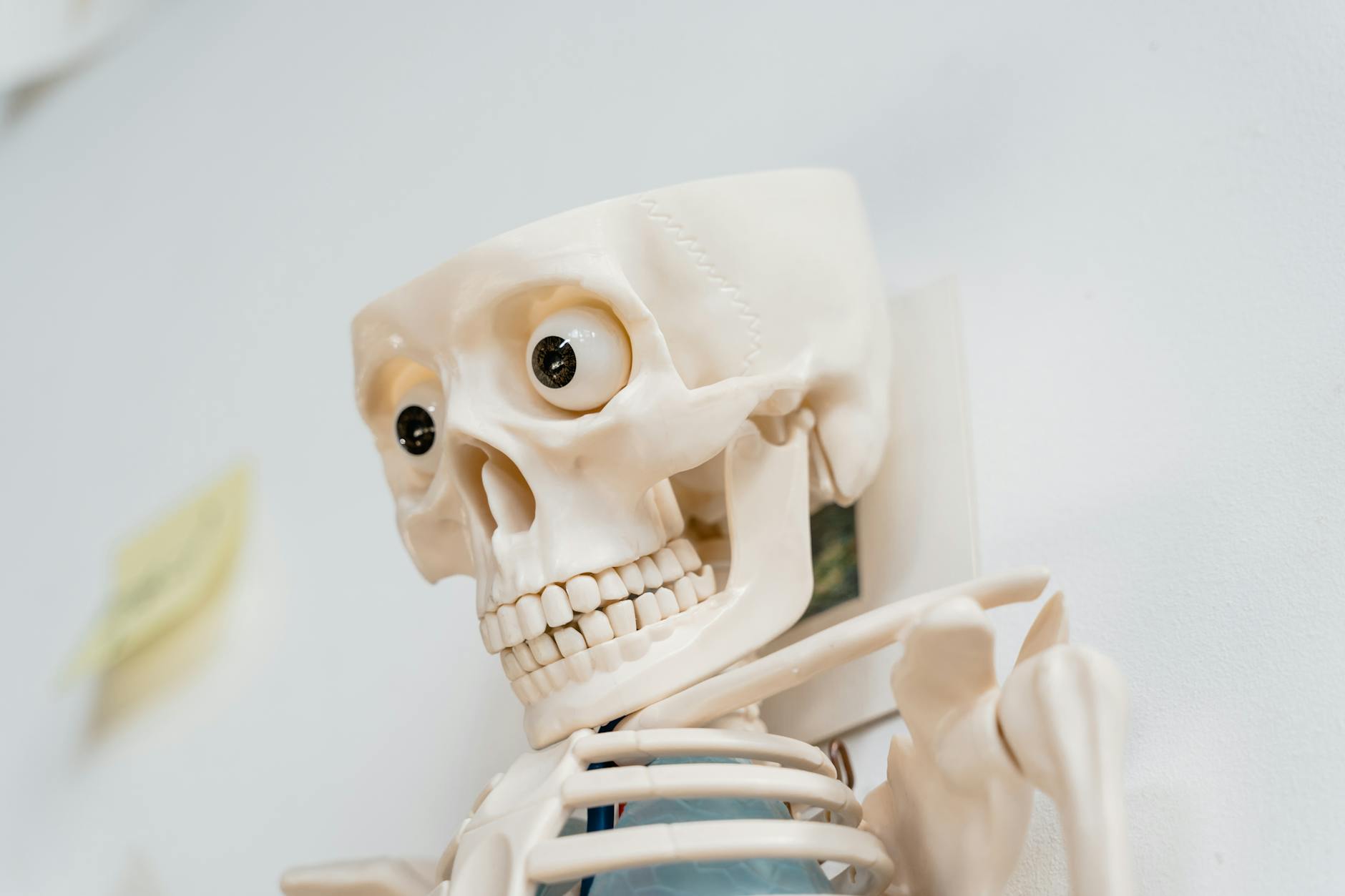
Working in pairs, they teach topics aligned with the National Curriculum – such as the digestive system (year 4), the skeleton (year 3) (see photo) and Our superhero bodies (year 1).
Teaching about the skeleton – Zara and Milly from the 2025 SCP cohort.
As part of the programme, students write three reflective journal entries (before, during and at the end of the project). This is a method of formative assessment designed to foster critical thinking, self-awareness and help them think about their professional identity formation.
This blog shares some of these reflections from three third year medical students – Alex, Sharon and Zara – who took part in the 2025 cohort. Their insights reveal how learning to teach helped strengthen their communication and study skills, and highlights the power of feedback, which they align with their professional identity development as future doctors.
How does teaching help you become a doctor? – Alex.
Teaching and learning are core parts of good medical practice (GMC, 2024). This is for a variety of reasons – as future physicians we are responsible not only for the education of our junior colleagues but also the patients we are treating. Having a foundation of education science can help you explain complex conditions to patients of all ages and abilities. In a recent study it was found that higher satisfaction in physician-patient communication led to statistically better outcomes for patients (Świątoniowska-Lonc et al., 2020). Reasons for this included “feeling encouraged to ask questions” and “talking in terms you can understand” and were keys ways in which patients felt they could be better served. This in turn led to better adherence and thus better outcomes for patients with high blood pressure.
Learning how to teach has also helped me understand how educators design and plan lessons, which I have found to be useful for my own learning in medical school. By understanding SMART learning objectives (Specific, Measurable, Achievable, Relevant and Time-bound), it allows me to more effectively engage with the lesson. Iit helps me more accurately grasp what I’m meant to be taking from each lecture and workshop, and how assessments are constructively aligned with the intended learning outcomes
Finally, it provides many transferable skills which can help with the ability to plan and organise projects which will be relevant throughout medical school and beyond. Skills which are used every day in teaching like public speaking, PowerPoint creation, and general project planning. These are useful skills for a future clinician. For example quality improvement projects and new research will be easier having acquired these new skills through the medium of teaching.
Overall this SCP has been a valuable part of my medical education in helping me prepare for my future career, my current studies and proving me with the soft skills on which I can rely on in the future.
The importance of medical students/professionals doing their best to develop good child-centred communication skills for a career in Paediatrics – Sharon.
It isn’t surprising to anyone that if adults find hospitalisation to be a distressing experience, then it is undoubtably scary for children. What can make this experience worse for children though is their sense of heteronomy as their carers are making their decisions for them (Machado et al., 2024). In fact, this can induce anxiety leading to the display of negative behaviour, slower recovery, and low self-esteem (Stylianou, 2021). Just imagine being in a room surrounded by people making decisions about your body in a language you might not understand and without giving you an explanation as to why and what is happening – this needs to change!
Research shows that one of the best ways to combat this is through clinical professionals having effective child-centred communication skills and making the children feel as involved in their healthcare as possible (Abazari et al., 2025). There are many lessons regarding this that I took away from my SCP that may also be useful to you. For instance, my biggest takeaway was the importance of having a good, friendly demeanour and building rapport. A big smile, light-hearted humour and answering questions builds trust. It makes the children feel heard and listened to, making them more inclined to open up to you.
Despite being a contested theory, learning about VARK modalities of learning styles (Visual, Aural, Read/write, and Kinesthetic) compelled me to reflect on how this can be applied to Paediatrics. For instance, drawings can explain and teach children about procedures or about what is wrong in their body. Children are often also hesitant to partake in examinations due to their fear of medical instruments, so you could also let them use, for instance a stethoscope, on you or their caregiver first. All of contributes to combating their fear of the unknown, so patients are more cooperative.
Finally, research shows that there is a prevalent issue of confidence amongst medical students in communicating with paediatric patients and their caregivers (Abazari et al., 2025). This is due to a lack of paediatric exposure, so it is extremely important for students to pursue opportunities for this. This could be through SCPs like this one or participating in your university’s Paediatrics society or Teddy Bear Hospital society (https://www.teddy-bear-hospital.com). I’m sure there are many more opportunities out there – it’s just a matter of putting yourself out there to ultimately provide the best care for your future patients!
The value of feedback – Zara
Having never previously designed or delivered a teaching session for a primary school class, I knew I would be relying on feedback both from my peers and project leaders throughout the process to help shape the lesson plan. The end goal was creating an enjoyable and educational classroom experience for the children.
I believe the feedback we received and the opportunity to action it played a major part in creating a positive experience not only for the children but also for us as teachers. It allowed us to create a lesson plan that was fun, interactive and engaging for the pupils, which then made our job as teachers easier on the day because the children were actively participating and seemingly enjoying our lesson.
An example of a valuable piece of feedback I received was to leave time at the end of the lesson for the children to ask questions instead of trying to fill all of the time with activities. Research shows that when children are involved in their own learning, such as by asking questions, they will likely be more enthusiastic about the learning (Harle, 2001). Based on this feedback and research, we decided to leave 10 minutes at the end for a Q&A, which the children definitely took advantage of.
Although it was tempting to want to fill all of the lesson time with pre planned activities to try and ensure the children made the most of the learning time, in hindsight I think the question time might have been their favourite part of the session and they probably could have spent another half an hour asking questions if we had let them. Therefore, this piece of feedback definitely positively impacted our lesson and the children’s experience, in terms of both their enjoyment and hopefully their understanding of the topic, and my ability to plan a learning session.
Final reflections
These reflections underscore a central message – learning how to teach can play a valuable component of our future medics’ professional development. From Alex’s emphasis on transferable skills and patient communication, to Sharon’s focus on child-centered approaches in pediatrics, and Zara’s appreciation of feedback as a tool for learning, each perspective illustrates how the opportunity to learn how to teach can enrich medical education. By stepping into the role of educator, students can develop skills that will serve them through their careers.
Moreover, the SCP model is transferable beyond medical education and aligns with University of Bristol’s Education Strategy. Through its emphasis on authentic, inclusive and applied learning, designing and delivering teaching for a real audience could benefit students across disciplines. Social science students might facilitate sessions on ethics or social issues, whilst science and engineering students could communicate skills such as sustainability or digital literacy. In each context, students consolidate subject knowledge while developing confidence, communication skills and responsiveness to feedback. Embedding approaches like this across programs supports Bristol’s aim to develop graduates who can translate academic learning into real-world impact
References
Abazari, L., Ghonchehpour, A., Abazari, A., Isari, Z., Abbaszadeh, M.H. and Tavan, A., (2025). Experiences of children during hospitalization: content analysis of interviews and paintings. BMC pediatrics, 25(1), p.183.
General Medical Council (GMC). (2024) “Good Medical Practice.” GMC, 30 Jan. 2024, www.gmc-uk.org/professional-standards/the-professional-standards/good-medical-practice.
Harle, W. (2001). Research in primary science education. Journal of Biological Education,
35(2), pp.61–65.
Machado, J., Negrão, B.J., Rodrigues, M., Goulart, P. and Appenzeller, S. (2024). Communication skills in pediatrics: perception of medical students. BMC Medical Education, [online] 24(1). doi:https://doi.org/10.1186/s12909-024-06578-6.
Stylianou, M. (2021). Supporting children with procedural anxiety. [online] GOSH Hospital site. Available at: https://www.gosh.nhs.uk/news/supporting-children-procedural-anxiety/.
Świątoniowska-Lonc, N., Polański, J., Tański, W. and Jankowska-Polańska, B., (2020). Impact of satisfaction with physician–patient communication on self-care and adherence in patients with hypertension: cross-sectional study. BMC health services research, 20(1), p.1046.


Leave a Reply